Massachusetts campaign finance
How former Massachusetts officeholders keep spending long after leaving office
When Karyn Polito stopped being lieutenant governor of Massachusetts in January 2023, her campaign committee did not stop being a campaign committee. That same week, the committee spent over $20,000 on an end-of-term celebration, lodging at the Omni Parker House and food at Rare Steakhouse. Three years later, the account remains open — and still spending.
Stanley Rosenberg's committee spent $89,009 on a painting of himself after he left the Senate in May 2018, amid a scandal involving his husband. Harriette Chandler spent $24,716 on her portrait. Two Senate presidents, $113,725 of donor money on portraits.
Paul Haley left the Massachusetts House more than two decades ago. His committee was still spending in April 2026 — but only to perpetuate its own existence. Nearly all of its payments are for tax return preparation, or to the IRS.
Massachusetts campaign-finance records show that former state officeholders — legislators, mayors, sheriffs and constitutional officers — have continued to spend committee funds long after they last appeared on a ballot. At least 76 former state and municipal officeholders kept spending campaign money, totaling more than $6.5 million after they left office. By far the largest spender is former Boston mayor Martin Walsh.
Over half of those committees spent money within the last twelve months. 23 committees were still writing checks more than five years after their candidate's last day in office.
Who kept spending
Top 10 post-departure expenditures by former officeholder, Jan. 2021 – Apr. 2026.
Horizontal bar chart of the ten largest post-departure spenders. Martin Walsh leads at $3.55 million, more than five times the next committee.
| Former officeholder | Last office | Left office | Total spent | Payments |
|---|
Some of the spending looks like ordinary account wind-down: modest donations, unpaid vendor bills, a final payroll run. But other committees have functioned for years as active checkbooks with no campaign left to fund — underwriting farewell galas, paying steady consulting retainers and making six-figure gifts to hometown charities, long after the officeholder's name stopped appearing on any ballot.
Massachusetts campaign finance law gives former officeholders wide latitude to spend down committee balances, including on charitable giving. The law does not require a candidate who isn't campaigning to dissolve their committee — they can keep the account open if they think they might run again.
But the scale and duration of some of this spending raises questions about how much scrutiny these dormant-in-name committees actually get once the cameras move on — and how many transactions only make sense for someone still in office.
Dissolving a committee usually means giving away everything in it. State law requires a zero balance to close the account, and returning leftover funds to contributors is not allowed. That leaves officials with limited options for residual money: donate it to charity, a scholarship fund, or a state or local fund.
A committee that never officially closes can keep disbursing campaign funds indefinitely. For those who have actually stepped down from public office, there is no provision covering a candidate who simply left and did not come back.
What does "left office" actually mean? That depends on who you ask. "Former officeholder" is a category that exists in news reporting, not in the campaign finance statute. It can describe someone who switched from the public to the private sector. Some people leave office but continue their influence through donations to their network. Others are genuinely retired but keep spending — or are waiting for a comeback.
Comment was sought from every official named in this article. Some did not reply; others could not be reached. Former Suffolk County district attorney Daniel Conley said in a written statement that he remains active in local and state politics and has "not ruled out seeking public office again."
"As long as that possibility remains open, I believe it is appropriate to maintain my campaign account," he said.
Treemap of post-departure spending, sized by dollars and grouped by category. Shows all 76 committees combined unless a single officeholder is selected. Internal transfers between a committee's own accounts are shown as a separate hatched category, since they are account movements rather than spending.
| Date | Former officeholder | Paid to | Category | Purpose | Amount |
|---|
Martin Walsh resigned as mayor of Boston in March 2021 to become U.S. secretary of labor. Two years later he became president of the NHL Players' Association. But his mayoral campaign committee has stayed busy for five years.
The Dorchester Democrat's committee has spent over $3.5 million in the five years since he left City Hall, including continuing payments to the fundraising firm that employs his wife and gifts to a nonprofit where he sits on the board.
The scale is large — a committee with no election to fight spent at nearly the rate of one running a city. Over the identical window, Mayor Michelle Wu's committee spent about $3.6 million, most of it on staff payroll.
Two committees, two purposes
A sitting mayor's committee pays staff. A departed mayor's committee gives money away, Nov. 16, 2021 to Apr. 30, 2026.
Grouped bar chart comparing spending categories. Wu's largest category is payroll and staff at 23.2 percent; Walsh's is charitable and sponsorship giving at 58.9 percent, with no payroll at all.
| Category | Wu | Walsh |
|---|
The largest single post-departure relationship is with a consulting firm, LB Strategies, and its owner, Laurie Bosio, which together received $289,650 between April 2021 and April 2026 for fundraising and campaign "consulting." Lorrie Higgins, Walsh's longtime partner whom he married in 2024, has worked for the firm as a fundraising consultant since 2014.
Over half of Walsh's spending has gone to charities and organizations. The committee has given a combined $340,250 since 2022 to the Gavin Foundation, a South Boston addiction-treatment and recovery nonprofit. Walsh has spoken publicly about his own recovery from alcoholism since the 1990s. He worked on addiction legislation as a state representative and created a municipal Office of Recovery Services as mayor.
A South Boston behavioral health clinic, the Joseph Nee Collaborative Center, gives a Martin J. Walsh award; its 2023 recipient was John McGahan, Gavin's president. Walsh's committee has given $37,750 to the Nee organization, which says on its website that the award event is sponsored by the Walsh committee.
The committee has also given $115,000 since 2022 to Camp Harbor View, a Boston youth summer camp and leadership program where Walsh serves as a board director. Beyond those threads, it has directed $315,000 since 2023 to the Massachusetts Democratic Party — a common and generally permitted way for a committee to dispose of surplus funds. The remainder is spread across dozens of smaller gifts to South Boston and Dorchester community organizations: youth programs, addiction and recovery services, and Catholic charities.
Three of the five largest recipients have a personal connection to Walsh
The five largest recurring recipients of Walsh committee spending since March 2021.
Bar chart of the five largest Walsh committee recipients, led by the Gavin Foundation at $340,250.
Karyn Polito left office as Massachusetts' 72nd lieutenant governor on Jan. 5, 2023, after eight years alongside Gov. Charlie Baker. Three years later, her committee is still paying a monthly retainer to a former State House aide and making gifts to the hospital system that now employs her.
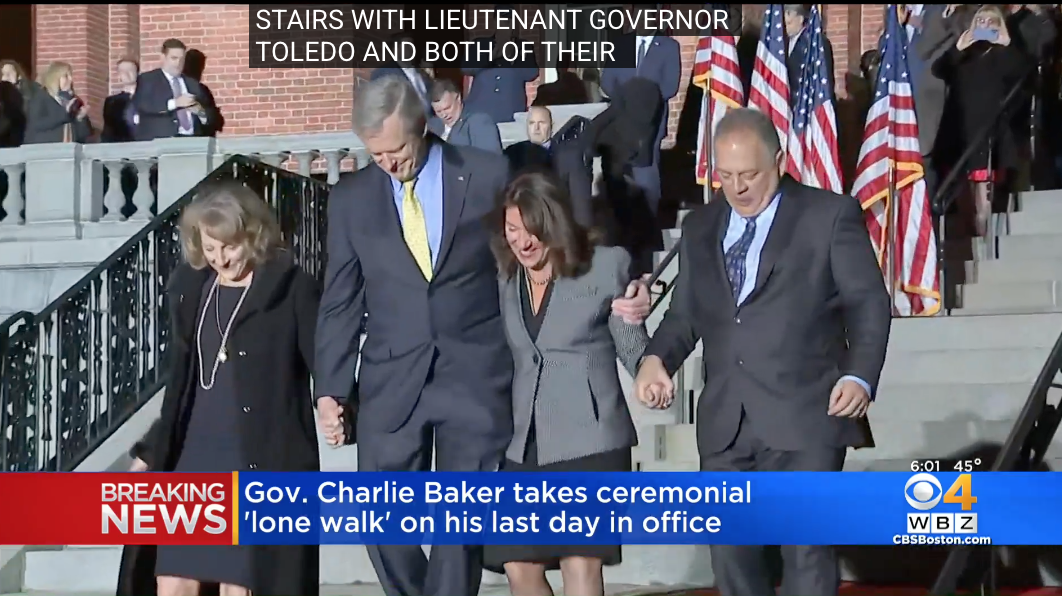
In the first month after her departure, Polito's committee paid $44,569 to Conventures, an event planning and PR firm, for a "Baker send-off event" and facility rental, and $12,785 to Capron Lighting & Sound for services tied to "Governor Baker's Lone Walk." The farewell event drew nearly $60,000 from the committee.
The largest single recipient of the committee's payments is Christian H. Nakkashian, who by his own biography served as Polito's executive assistant in the lieutenant governor's office from November 2021. He left government at the same time Polito did and, according to his public bio, immediately joined Regan Communications Group, where he was later promoted to president of operations.
Records show Polito's committee began paying Nakkashian $2,500 a month starting in March 2023, two months after her departure, rising to $3,000 a month by mid-2024 and continuing on a monthly schedule through at least March 2026 — filed as "campaign consulting."
Since leaving, Polito has moved into the private and nonprofit sector. She is vice president of business development in the executive office at UMass Memorial Health, and continues to run her family's real estate development and commercial leasing business. Her outside directorships include Clean Harbors, Berkshire Bank and The Andover Companies. Polito's committee has given $22,700 to the health system she now works for, between April 2024 and February 2026.
Polito has not run for office since 2023, which raises a specific question: what campaign has a former state aide been paid to consult on?
Former House Speaker Robert A. DeLeo left the chamber at the end of December 2020. Since then his committee has spent roughly $100,000 every year for five years running, most of it to charitable nonprofits, schools and senior programs — nearly all of them in Winthrop and Revere, the two communities he represented for three decades.
In September 2025 the committee gave $30,000 to Friends of the Winthrop Council on Aging, a small Winthrop charity where DeLeo is president of the board of directors. The charity funds the Robert A. DeLeo–Winthrop Senior Center, a building the Winthrop Town Council voted to rename in his honor in September 2011, while he was the sitting speaker.
Brian S. Dempsey resigned as chairman of the Massachusetts House Ways and Means Committee on July 19, 2017 — one of the most powerful budget positions in state government. Unlike those who retired at the end of a long career, he went directly into lobbying: first to ML Strategies, then, after his one-year cooling-off period expired in July 2018, into his own firm on Beacon Street. Today he is president of Dempsey Associates, one of the most successful lobbying shops on Beacon Hill.
His committee has spent $183,253 since 2021, of which $107,000 was political giving. The money went to PACs, party committees and an inaugural committee: $35,000 to the House Victory Fund PAC, $13,000 to the Massachusetts Democratic State Committee, and a $15,000 contribution to the Healey Driscoll Committee.
OCPF limits lobbyist giving to a ceiling of $200 when giving to candidates, PACs and state party committees alike. Where an ordinary person may give $1,000 to a candidate and $5,000 to a party, a registered legislative agent may give $200.
Dempsey's candidate committee, which has not closed in the nine years since he left the House, has directed $107,000 to political committees. State law restricts "contributions by a legislative agent".
Dianne Wilkerson represented the 2nd Suffolk District for fifteen years, the first Black woman elected to the Massachusetts Senate. In 2008 the FBI arrested her on public corruption charges for accepting bribes totaling $23,500. She lost that September's Democratic primary to Sonia Chang-Díaz and resigned from the Senate. She served three years in prison and was released in 2013.
Fourteen years after she left the chamber, her committee spent $48,214 in the six months before the September 2022 primary, as she tried to regain the seat she had lost — on signs from Get Set Marketing, and staff payroll. The seat had opened because Chang-Díaz, who beat her in 2008, was giving it up to run for governor. Wilkerson's committee stopped spending and closed one year after the primary.
Althea Garrison's ledger has a different rhythm. She left the Boston City Council in January 2020 and her committee has spent about $16,700 since, most of it to printers and local papers — Studio 24 and Copy Clone for flyers and posters, ad buys in the Dorchester Reporter and the Bay State Banner. Her spending climbed ahead of the November 2021 and 2023 elections and flatlined in between.
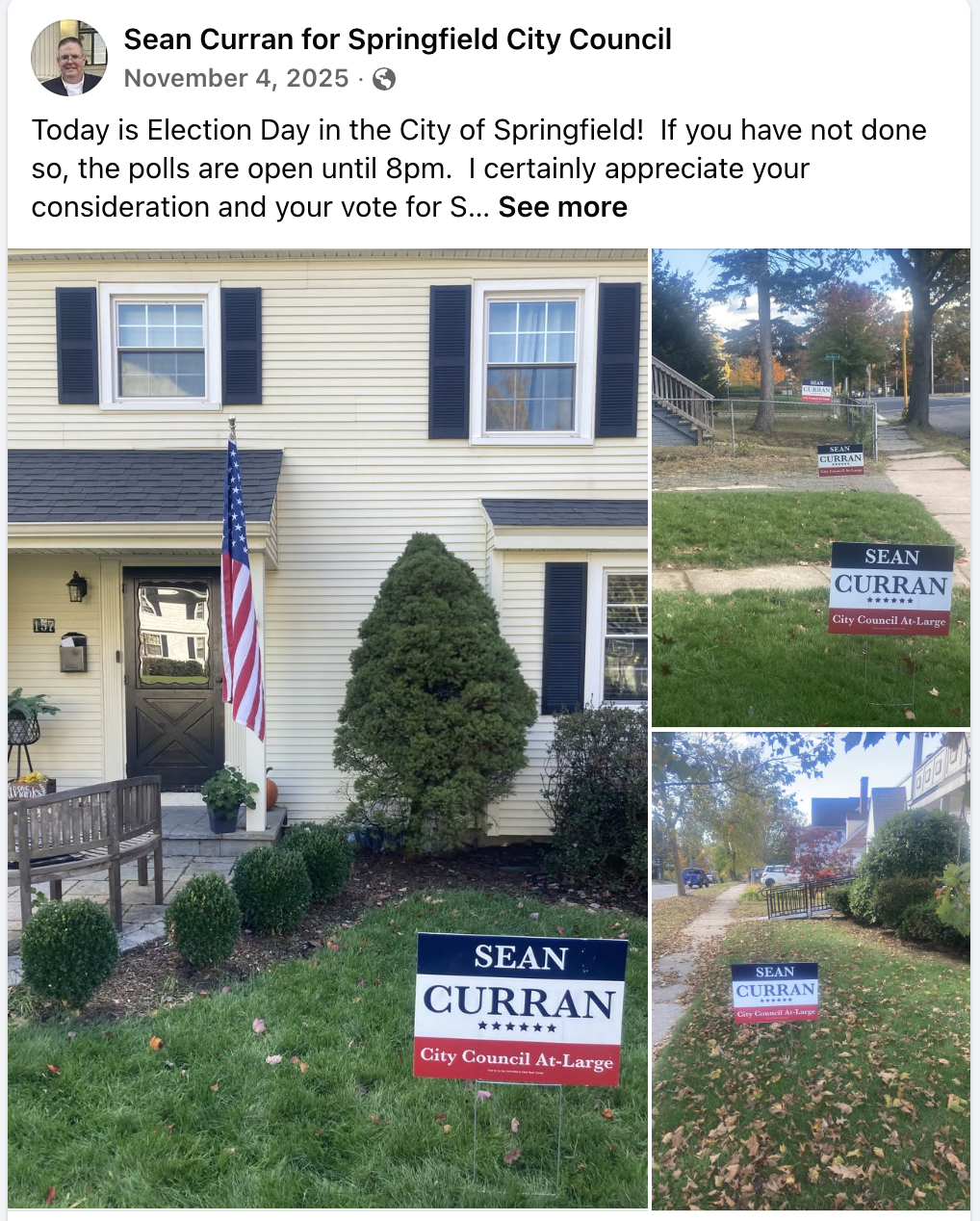
Sean Curran's committee follows the same pattern over a longer run. He represented Springfield's 9th Hampden district from 2005 until Jan. 7, 2015, when he declined to seek re-election. His committee has spent $39,976 since 2021 — more than a decade after he left office — and it spends in odd years: $10,688 in 2021, $11,831 in 2023, $12,732 in 2025. Springfield holds its municipal elections in odd years. The money goes to direct-mail postcards from Marcus Printing in Holyoke, newspaper advertising in The Republican, robocalls, lawn signs and wire posts.
Marc Pacheco left the Massachusetts Senate on Jan. 1, 2025, after decades representing Taunton. But he is still busy in conference. He told the Boston Globe he had no intention of retiring.
Four months after his term expired, the committee spent $4,533 on what was labeled a "legacy of public service event" — $3,558 to Paiva's Catering, $750 to a musician, $225 to rent a hall at the Portuguese American Civic Club. Five months later another "thank you" barbecue was held: on Sept. 7, 2025, the committee spent $4,173 on a barbecue caterer, $500 for a band called the Baha Brothers, $300 for a pavilion rental at the same club, and $284 for printing tickets.
Last August the committee paid $282 to Amtrak and $668 to a Hilton in Manhattan for Climate Week and the Clinton Global Initiative. A month later it covered another $1,336 at the same hotel and $83 for a restaurant charge. In September it put $354 into a Springfield Marriott for the state Democratic convention. This past April it spent $1,462 on a Nashville hotel and $1,003 on airfare for the Gore Climate Reality Conference. Climate policy was Pacheco's signature issue for most of his career. It also sent $2,499 to Bridgewater State University for a public-policy mission to Cape Verde and the Azores.
Daniel Conley spent in a similar way. He stepped down as Suffolk County district attorney in 2018 and now serves as a senior advisor at ML Strategies. His committee has spent $86,538 since 2021. There are JetBlue tickets to National District Attorneys Association meetings, one booked for "formation of its alumni association." There is an Aer Lingus ticket for an Irish American Partnership leadership mission and a Dublin hotel reserved "in advance of a visit with US Ambassador to Ireland." And every December, a run to Gary's Liquors for a holiday party for the volunteers of a campaign that ended in 2018.
Robert F. Fennell left the Massachusetts House in February 2016. The committee still lives on, and still buys postcards on schedule. It has spent $12,782 since 2021, most of it to Connolly Printing — every Christmas, about $1,500 for holiday greeting cards. Everything else in the account is small change, and almost entirely political courtesy: $100 here and $50 there to other candidates.
Paul Haley's committee is the purest case of an account that exists only to sustain itself. He left the House more than two decades ago; the committee has spent $12,583 since 2021, and nearly every payment is to an accounting firm for tax return preparation, or to the IRS itself.
Two Senate presidents spent $113,725 of donor money on portraits. Rosenberg's committee spent $89,009 on a painting of himself and its frame — to one portrait studio, Prosperi Studio, under three different bills in 2023 and 2024, plus $2,208 to Guido Frames. Harriette Chandler's committee paid $24,716 in three installments to a fine-arts firm for a State House portrait.
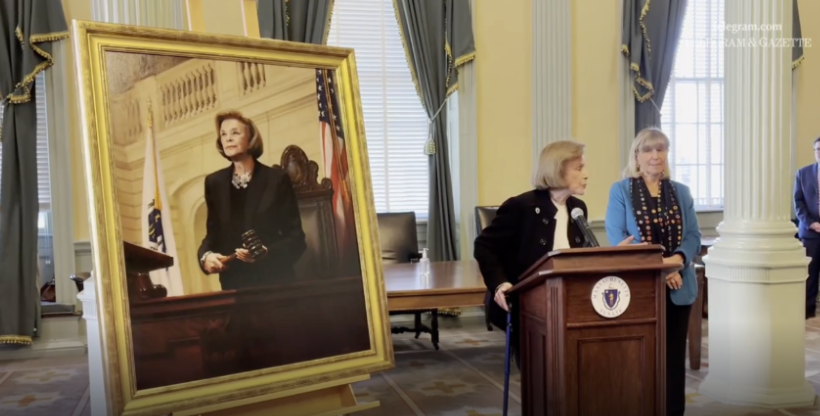
Campaign fund-bought official portraits are not rare in the State House. Former Gov. Charlie Baker unveiled his $29,000 official oil-on-canvas portrait at a private event in the State House library in 2023.